
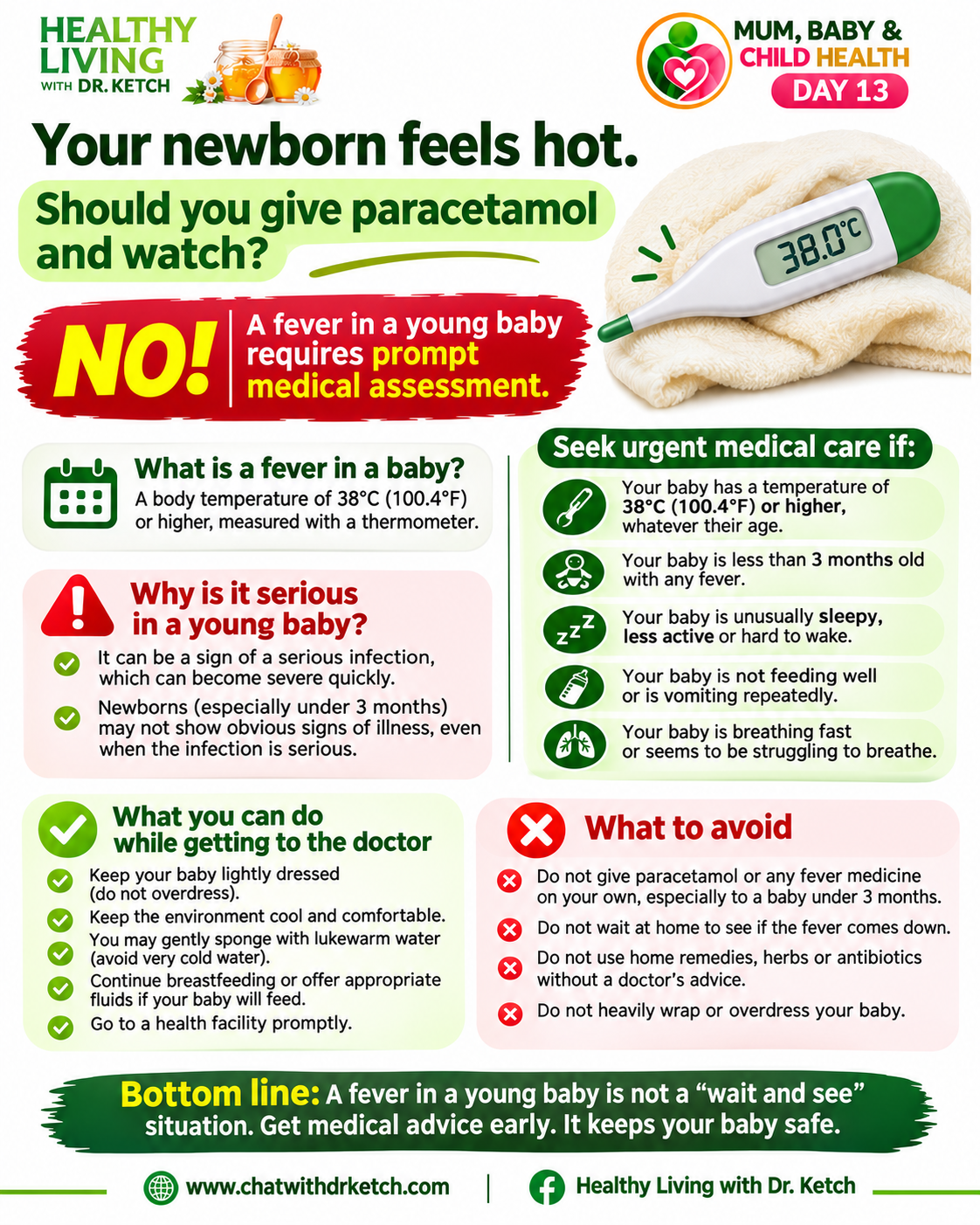
YOUR BABY IS JUST 2 WEEKS OLD AND HAS A FEVER. PLEASE DON’T GIVE PARACETAMOL AND WAIT!
A mother once sent me this question:
“Good evening Doctor. My baby is just 2 weeks of age and always has this high fever.”
Now, I know how tempting it can be to give a baby some paracetamol, remove a few layers of clothing and wait to see whether the temperature comes down.
But remember that fever in a newborn can be the first sign of a serious infection, even when the baby looks perfectly fine.
Babies this young can deteriorate very quickly. Sometimes, there may be no obvious symptoms apart from the fever.
SO, WHAT COUNTS AS A FEVER?
For a baby younger than 3 months, a temperature of 38°C (100.4°F) or higher requires immediate medical assessment.
Use a digital thermometer. All of us became used to this during COVID, right? ☺️ A rectal temperature is the most accurate measurement in young infants when taken correctly. If your baby feels unusually hot or you suspect a fever, seek medical advice immediately rather than delaying care while trying to get a perfect reading.
BUT WHAT IF THE BABY WAS WRAPPED IN TOO MANY CLOTHES?
Yes, excessive clothing can make a baby overheated.
Remove unnecessary layers and move the baby to a comfortably cool environment.
However, if a newborn has a measured fever, please do not assume it is simply because of the weather or too many clothes.
A fever may be caused by an infection that requires urgent investigation and treatment.
SHOULD YOU GIVE PARACETAMOL FIRST?
Not without medical advice.
Paracetamol may lower the temperature temporarily, but it does not treat a serious bacterial infection. It may also make parents think the problem has resolved when the baby still needs urgent care.
Do not delay going to hospital because you are waiting to see whether medication works.
WHAT ABOUT TEPID SPONGING?
Routine tepid sponging is no longer recommended for treating fever in children. It can make babies uncomfortable and does not prevent febrile seizures (fever convulsions).
And febrile seizures are uncommon in newborns; they typically occur in older infants and young children.
WATCH FOR THESE ADDITIONAL DANGER SIGNS:
– Poor feeding or refusing breast milk.
– Unusual sleepiness or difficulty waking.
– Fast or difficult breathing.
– Weak or unusual crying.
– Seizures.
– An unusually low temperature, particularly if the baby seems unwell.
These signs also require urgent medical attention, even if there is no fever.
Did you know that a fever in a newborn is treated differently from a fever in an older child?
#HealthyLivingWithDrKetch


